
Just a few months ago, Real Madrid looked untouchable. A team full of stars, led by one of Europe’s most promising young coaches, Xabi Alonso, had the fans dreaming of another glorious chapter in the club’s legendary history. But football changes fast — and at the Santiago Bernabéu, it changes even faster.
After back-to-back home defeats and only two wins in their last eight games, alarm bells are ringing in Madrid. The once unstoppable side now looks uncertain, disjointed, and increasingly short of ideas — a far cry from the ruthless Real Madrid we’ve come to know.
A Worrying Pattern Emerges
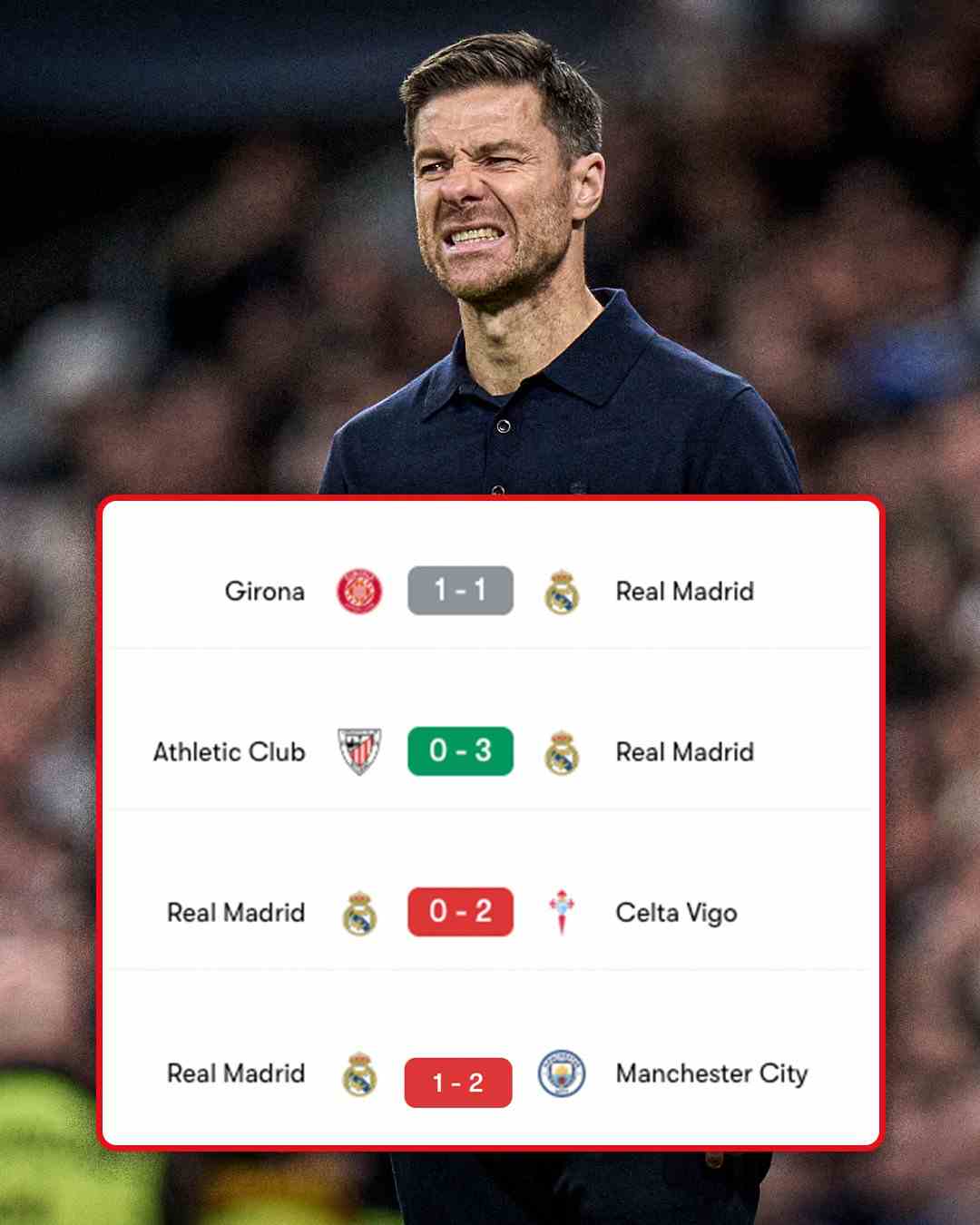
The recent 2–1 defeat to Manchester City was a bitter pill to swallow. It was only City’s second ever win at the Bernabéu — a ground once considered a fortress. A few days later, a 2–0 loss to Celta Vigo deepened the crisis, exposing Real’s lack of rhythm, confidence, and defensive organization.
Their recent run tells its own story:
- ❌ 2-1 loss vs Man City
- ❌ 2-0 loss vs Celta Vigo
- ☑️ 3-0 win vs Athletic Club
- 🤝 1-1 draw vs Girona
- ☑️ 4-3 win vs Olympiacos
- 🤝 2-2 draw vs Elche
- 🤝 0-0 draw vs Rayo Vallecano
- ❌ 1-0 loss vs Liverpool
Two wins from eight matches. For any club, that’s poor. For Real Madrid — it’s unacceptable.

Injuries Have Hit Hard, But Excuses Are Wearing Thin
It’s true that Madrid’s injury list looks more like a hospital ward than a football squad sheet. Key players like Dani Carvajal, David Alaba, Ferland Mendy, Éder Militão, Eduardo Camavinga, and even new signing Trent Alexander-Arnold are all sidelined.
Such absences have forced Xabi Alonso to shuffle his lineup constantly, often relying on academy talents or makeshift defenders. Without Carvajal’s experience, Alaba’s leadership, or Camavinga’s energy, Madrid’s defense looks fragile, and their midfield lacks balance.
But while injuries explain part of the problem, they can’t explain everything. The biggest concern is that even when fit players take the field, Madrid have looked tactically lost — unsure whether to dominate possession or play on the counter. Alonso’s famed tactical precision from his Bayer Leverkusen days has yet to translate fully to the Bernabéu.
Xabi Alonso Under Pressure
The Spanish media, as always, have turned up the heat. Rumors suggest that Madrid’s hierarchy are growing “concerned” with the team’s form and the manager’s struggle to find the right formula. Florentino Pérez is known for his patience — up to a point.
Xabi Alonso was brought in not just for results, but for evolution — to modernize Madrid’s football philosophy while keeping their winning DNA intact. But right now, his project feels uncertain. The fluid positional play that once dazzled fans in Germany looks disjointed in Spain. The pressing is inconsistent, and the attack often relies on individual brilliance rather than collective movement.
The Players Look Mentally Drained
Perhaps the most worrying sign is the body language. Players like Vinícius Jr. and Rodrygo look frustrated; Jude Bellingham, once Madrid’s unstoppable engine, appears burdened by responsibility. Even veterans like Luka Modrić seem emotionally fatigued.
It’s not just about tactics anymore — it’s about belief. Real Madrid’s aura of inevitability, that psychological edge that breaks opponents before kick-off, has faded.
Still, All Is Not Lost
Despite the gloom, this is Real Madrid — a club that has built its empire on comebacks and chaos. One good result could change everything. The Champions League knockout stages are approaching, and Madrid have a knack for rediscovering themselves when it matters most.
Xabi Alonso’s task now is as much psychological as tactical: rebuild confidence, rediscover identity, and remind his players who they are.
Football, like history, can be cruelly cyclical — but at the Bernabéu, even a storm can turn into sunshine overnight. For Xabi Alonso, this may well be the defining moment of his managerial career. Either he steadies the ship and silences the critics — or the Madrid machine moves on, as it always does.
